How to report a crypto scam in India
Call the 1930 cyber fraud helpline first, then file at cybercrime.gov.in with a complete evidence pack, then notify your bank in writing quoting the complaint number. Speed is the single biggest factor: for fiat fraud a beneficiary account can often be frozen within the first hours, while crypto transfers themselves are irreversible.
Crypto transfers are irreversible. Bank and UPI transfers, for a short window, are not. That window is the whole game — and most victims spend it arguing with the scammer instead of filing.
Step 0 — Stop, before anything else
- Stop all payments to the counterparty — including any “send half back and we'll settle this”.
- Do not delete the chat. Do not block them yet either; blocking can cost you evidence. Export first.
- Do not accept help from anyone who contacts you. Recovery-service scammers monitor complaints and approach victims within hours.
- Do not attempt to spend anything you received. If you were paid in counterfeit tokens, passing them on makes you a perpetrator. See the seller investigation.
Step 1 — Build the evidence pack
Complaints with complete evidence get actioned. Complaints without it get a reference number and silence. Assemble this before you file — it takes fifteen minutes.
| Category | What to collect |
|---|---|
| Crypto | Every transaction hash, sender and receiver wallet addresses, the token contract address, chain name, amounts, timestamps in IST |
| Fiat | UTR / reference numbers, UPI IDs, account numbers and IFSC, bank names, exact amounts and times, your statement showing the debit |
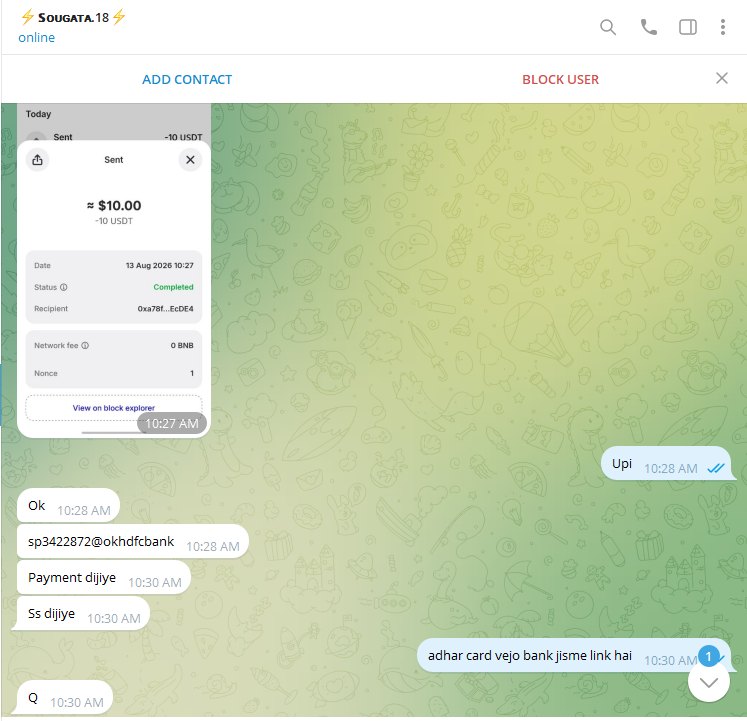
| Identity | Telegram or WhatsApp handle, phone number, profile screenshots, any name or KYC document supplied, the platform where you met |
| Communication | Full chat export with timestamps — not selected screenshots. Both Telegram and WhatsApp support exporting a conversation. |
| Chain proof | Explorer screenshots showing the counterfeit contract, any impersonation warning, and the sender wallet's history |
| Timeline | A plain chronological narrative: what was agreed, what was sent, when, and what you lost |
Step 2 — File, in this order
1Call 1930 immediately
The national cyber fraud helpline. Have your evidence pack open. This is the fastest route to a beneficiary-account freeze, which is why it comes before the portal.
2File on the National Cyber Crime Reporting Portal
cybercrime.gov.in, under Financial Fraud. Attach everything. Save the acknowledgement number — every later escalation references it.
3Notify your bank in writing
Email and phone, same day, quoting the complaint number. Ask explicitly for a hold request to the beneficiary bank. Verbal reports vanish; written ones create a record.
4Escalate to the beneficiary bank
If you have the UPI ID or account number, contact that bank's fraud desk directly with the complaint number.
5Visit the cyber crime cell for an FIR
For significant amounts an online complaint alone is not enough. Take printed evidence. An FIR is what unlocks a real investigation.
6Report the token contract on the explorer
Block explorers accept impersonation and scam reports. This is how counterfeits get flagged for the next person.
7Report the wallet to receiving exchanges
If funds moved to a centralised exchange deposit address, that exchange can freeze. Send them the hash and your complaint number.
8Report the account to the platform
Telegram, WhatsApp, YouTube — and to the P2P platform where you met, if any.
The second wave: recovery scams
Within days of filing, expect approaches. They are consistent and they are all fraudulent:
- “Certified blockchain recovery expert”, with a slick site and fake case studies
- Someone claiming to be from the cyber cell asking for a “processing fee”
- An offer to “trace and reverse” a transaction — technically impossible
- A “lawyer” requiring an advance retainer to an individual's account
- Anyone requesting your seed phrase or private key “to recover the wallet”
If you are a merchant or platform
- Preserve the order record, chat log, chain data and counterparty KYC before anything is closed.
- Report the counterfeit contract to the explorer — it protects every desk after you.
- Add the wallet and contract to your internal deny-list, and share the indicators publicly.
- If a mule account is involved, notify the beneficiary bank directly — receiving stolen fiat can freeze *your* account too.
- Full operational guidance: the P2P merchant survival guide.
The best recovery is not needing one. Every trade routed through escrow is a complaint you never have to file — KYC-verified counterparties, USDT locked before rupees move, and disputes resolved on chain evidence.
Trade USDT safelyFrequently asked questions
Can crypto sent to a scammer be recovered?
The blockchain transfer itself cannot be reversed by anyone. Recovery is only possible if the funds reach a centralised exchange that can freeze the account, which is why reporting the hash to exchanges quickly matters.
How fast do I need to report UPI fraud?
As fast as possible — within the first hours. Beneficiary accounts can often be frozen before the money is moved onward, but that window closes quickly. Call 1930 before doing anything else.
Someone offered to recover my stolen crypto for a fee. Is it real?
No. Paid crypto-recovery offers that approach victims are a follow-up scam without exception. No legitimate authority charges a fee by UPI or crypto, and no recovery process ever needs your seed phrase.
References
Primary sources for the rules and mechanics described above. Rules change — check the original before you act on anything here.
- 1National Cyber Crime Reporting PortalMinistry of Home Affairs, Government of India
- 2How Tether worksTether
- 3Tether reserves and transparency reportsTether
- 4Sanchar Saathi — report fraud communicationsDepartment of Telecommunications, Government of India
- India
- reporting
- recovery
- UPI